Mind you, Brooks is about a half-hour from where my folks live...
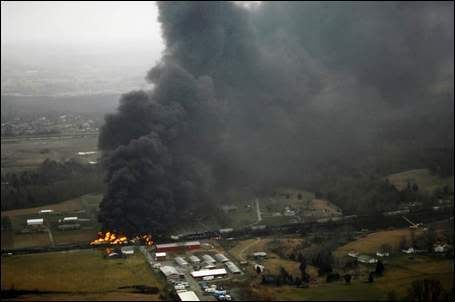
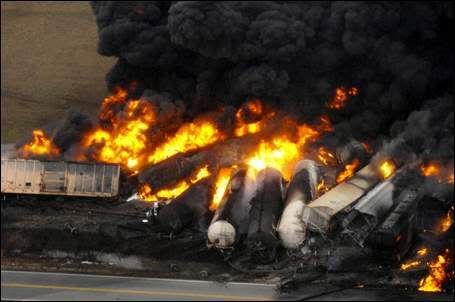
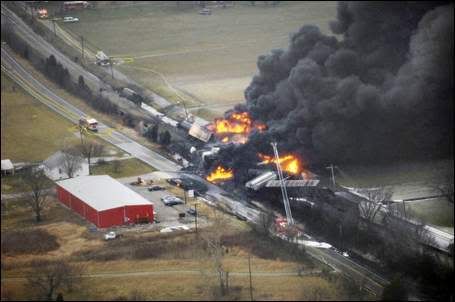
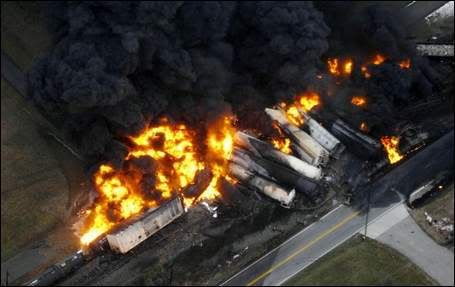
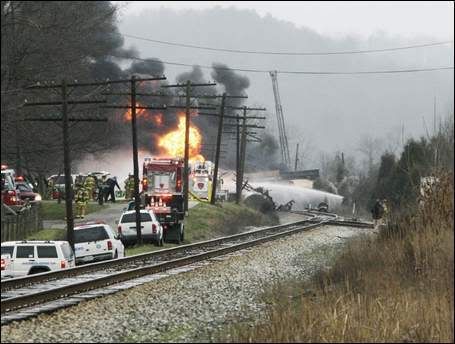
Monday:
Kentucky train crash releases chemicals
Jan. 15, 2007, 4:42PM
© 2007 The Associated Press
IRVINE, Ky. — Four runaway rail cars struck two parked locomotives Monday in east-central Kentucky, causing a fire and spilling a chemical that prompted a limited evacuation and orders that others stay indoors.
The crash released butyl acetate, a flammable liquid, from a burning tanker car, authorities said. The fire produced a huge column of black smoke, and a section of the Kentucky River where fuel or chemicals had spilled caught fire. No injuries were reported, authorities said.
The fire in the tanker car was extinguished by 3 p.m. EST, and smaller fires in the locomotives would be allowed to burn themselves out, authorities said.
The burning tanker car contained about 30,000 gallons of butyl acetate, said CSX spokesman Gary Sease. Butyl acetate is commonly used as a solvent or as a synthetic fruit flavoring.
Police ordered people in the immediate area to evacuate, and people in others part of Estill County were told to stay indoors, keep their windows closed and to put towels under doors.
Four CSX rail cars left their track shortly before noon and went onto a main rail line, traveling several miles before hitting the parked CSX locomotives, Sease said. CSX placed the locomotives in the path of the runaway tankers to stop them, said Buddy Rogers, a Kentucky Emergency Management spokesman.
Both the locomotives and rail cars were unmanned, Kentucky State Police Maj. Lisa Rudzinski said.
And then on Tuesday:
Derailment inquiry asks why
Train recorder may offer some answers
By James Bruggersjbruggers@courier-journal.comThe Courier-Journal
Jan. 17, 2007
As a raging chemical blaze began to die back and evacuees began returning home last night [Tuesday]near the scene of a CSX derailment, interest shifted to what a recorder taken from the train could tell about the cause of the wreck that turned Bullitt County upside down.
The recorder may provide clues to why the CSX train and its four locomotives left the rails near Brooks about 8:45 a.m., releasing clouds of black smoke that prompted at least 28 people to seek medical care.
The blaze closed Interstate 65 and forced the evacuation of hundreds from homes, businesses and schools.
I-65 reopened about 7:30 last night but could close again today as hazardous materials are hauled away. No timetable has been set.
Around 8 p.m., people living east of Interstate 65 were allowed to return home.
But Bullitt County Judge-Executive Melanie Roberts warned later that more evacuations could take place if the wind shifts. Residents again would be notified by radio and warnings delivered door-to-door.
The 80-car train, heading from Birmingham, Ala., to Louisville, derailed near Huber Station Road. Twenty-five cars went off the track and at least 14 caught fire. Twelve of those contained hazardous materials, CSX and federal officials said.
But the two Louisville-based train crew members escaped injury, CSX and state officials said. The company declined to identify them.
An unknown chemical was found on the surface of several tributaries to the Salt River last night -- but it was not known if it was runoff from the derailment, said Art Smith of the U.S. Environmental Protection Agency.
Smith said the state, the EPA and CSX are expected to sample the chemicals. The state also will evaluate whether wells in the area may be contaminated, Smith said.
Just before 9 p.m., a wave of fatigued firefighters returned to the command center at Station 1 of the Zoneton district.
Empty Gatorade bottles and Wendy's chili containers remained on the TARC bus that carried nearly 35 firefighters from Okolona, Mount Washington and Zoneton back to the station to rest.
Mark Quire, a Zoneton volunteer firefighter, spent about 12 hours at the derailment before returning to the station but expected to return to the scene at midnight. He said firefighters mostly watched the fire burn, staying nearby in case of an emergency.
Late last night, firefighters had begun flowing foam onto a fire in a hopper car that contains plastic pellets, Zoneton Chief Rob Orkies said.
They were also aiming water from large aerial hoses at the hopper. "The (amount of) water that we are flowing is ungodly -- and we're not making a lot of headway," he said.
Orkies said he was unsure how many cars were still on fire at 10 p.m. The risk of explosion was minimal, he said.
Officials declined to speculate on the cause of the derailment, saying their initial concerns dealt with the safety of people in the area.
The National Transportation Safety Board sent seven investigators and its chairman, Mark Rosenker.
"This is a pretty catastrophic accident as it relates to derailments and a gas evacuation," Rosenker said, adding that the NTSB investigates only 16 to 18 of the 3,000 to 4,000 rail accidents each year.
He said yesterday afternoon that officials were downloading information from the train's recorder to help them determine such factors as its speed and braking. The federal team will be in the area three or four days, he said.
The massive blaze forced the evacuation of everyone within a mile, while other Bullitt County residents were told to stay inside.
It was CSX Transportation's second major train accident within 24 hours in Kentucky, which Gov. Ernie Fletcher said "raises our concern more than normal."
"We regret, obviously, what has happened here," CSX spokesman Bob Sullivan said. "We will work with the investigative agencies to find out what happened and why it happened."
The crash affected thousands.
Among them was Sandy Osborne of Fox Chase, who used blankets and mats to fill cracks under the doorway so that chemicals would not seep in. Several times during the day, Osborne said she watched through windows as smoke billowed into the sky nearby.
She said she first heard about the derailment from her brother, who was watching television. "I heard the fire sirens. He called me and said, 'Turn it on.' "
Margaret Belcher, 82, said she was waiting for her son, Larry, who lives in Fox Chase, to pick her up at her house on Ky. 1020 and take her to safety.
She said she is concerned about the home where she has lived since 1974. "I don't know what to expect," she said.
And Kerri Ducey, a parent with a third-grader at Brooks Elementary, said she saw the news while at work. "It scared the hell out of me," she said, adding that she was going to take her child home.
Eleven evacuated families were staying at a Red Cross shelter last night at Okolona Christian Church, authorities said.
Fletcher said he expects CSX to reimburse state and local officials for the costs involved in responding to the derailment.
Sullivan said CSX would do so and also would assist businesses that lost money.
Another company spokesman, Gary Sease, said company environmental experts at the scene said a combination of the toxic chemicals 1,3-butadiene, cyclohexane and methyl ethyl ketone were burning.
While the train carried a variety of chemicals and other freight, state and local emergency management officials said they were most concerned about the cyclohexane, a colorless liquid used to make nylon and as a solvent.
Its vapors can cause serious lung damage.
Earlier news accounts that liquid propane might have been involved were incorrect, officials said.
Twenty-eight people were treated for eye irritations and respiratory distress, hospital officials said.
Yesterday's derailment was the first since July 9, 2003, in Kentucky involving a CSX train that required an evacuation, according to federal records.
But on Monday, four runaway CSX train cars rolled from near Winchester almost to Irvine, covering 20 miles before they hit two engines and caused an explosion.
Some homes and business were evacuated, but no hazardous materials leaked.
Reporter James Bruggers can be reached at (502) 582-4645.
Laura Ungar, Charlie White, Andrew Wolfson, Jessie Halladay, Daarel Burnette II, Marcus Green and Brandy Warren contributed to this story.
And a better summary/story:
Train Blaze Continues to Burn in Ky.
Train blaze continues to burn in Kentucky; Officials say some spots will have to burn out
BROOKS, Ky., Jan. 17, 2007
By DYLAN T. LOVAN Associated Press Writer
(AP) Thick, billowing smoke and flames fed by volatile chemicals leaking from a derailed train continued to belch into the sky Wednesday, frustrating officials long after the accident shut down a highway and forced evacuations.
Fire officials used 2,000 gallons of foam and an "ungodly amount" amount of water to extinguish some of the flames, but other spots will likely have to burn out on their own, expected later Wednesday.
Foam has proven more effective, said Maj. Garry Key of the Zoneton Fire Department. "The foam smothers the flames."
The derailment Tuesday morning caused no serious injuries, but at least 11 people near the crash site south of Louisville checked themselves into a hospital and were soon released, authorities said. Officials asked residents within a mile to evacuate.
The blaze produced a large column of black smoke in the mostly rural area. Television footage showed several blazing CSX cars stacked across the rail lines and flaming liquid flowing down ditches from the mangled tanker cars.
Bullitt County resident Daymon Strange said he was outside his home less than a half-mile from the crash site when he heard an explosion.
"I turned around and looked and there was fire at least 500 feet in the air," he said in a telephone interview. "I've never seen such a fire. It was huge."
The chemicals released when 12 of the train cars derailed were cyclohexane, methyl ethyl ketone, butadiene and alcohol, said Gary Sease, a CSX spokesman.
"These substances themselves are pretty toxic, but when they burn they break down a whole lot," said Jeremey Urekew, a spokesman for Bullitt County Emergency Management. "This fire is going to burn itself out."
Two other cars were carrying hazardous materials that could pose an environmental threat, but they were not near the fire. The train _ with four locomotives and 80 cars _ was headed to Louisville from Birmingham, Ala.
The crash closed an 18-mile stretch of Interstate 65 for about 11 hours. The Kentucky National Guard said it mobilized 20 to 25 soldiers and airmen to check air quality.
Art Smith of the U.S. Environmental Protection Agency said officials would continue to monitor the air and that a nearby creek would be sampled and private wells identified for monitoring.
The Red Cross set up a shelter in neighboring Jefferson County for evacuees, but only about a dozen people had checked, said William Ney, a volunteer.
Mark Rosenker, chairman of the National Transportation Safety Board, said the event recorder from the train would be sent to Washington for reading.
The track had been inspected by CSX inspectors on Monday, Rosenker said. Results of toxicology tests performed on the two-man crew were expected within two weeks, he said.
It was the second fiery train crash in Kentucky in two days. On Monday, four runaway rail cars struck two parked locomotives in central Kentucky, catching fire and spilling a chemical that prompted a limited evacuation.
©MMVII The Associated Press. All Rights Reserved. This material may not be published, broadcast, rewritten, or redistributed.
CHEMICALS INVOLVED
Bullitt County and CSX officials have identified these chemicals as being involved in the explosion and fire on the train:
Cyclohexane--A colorless liquid with a faint, ether-like odor used in the production of nylon and as a solvent. The chemical is extremely flammable as both a liquid and vapor. It irritates the respiratory tract and can cause severe lung damage. High concentrations can have a narcotic effect. It can cause abdominal pain and nausea. It also can irritate the skin, causing redness, itching and pain. If released into the soil, it is expected to evaporate quickly, although some may leach into groundwater. If released into open water, it is expected to evaporate quickly but is considered slightly toxic to aquatic life.
Methyl ethyl ketone--A colorless liquid with a sharp, mint-like odor used as an industrial solvent and in the production of synthetic rubber. The chemical is extremely flammable as both a liquid and vapor. It irritates the nose and throat and may cause headache, dizziness, nausea, shortness of breath and vomiting. Higher concentrations may damage the central nervous system and cause the victim to lose consciousness. Breathing the chemical can cause severe lung damage. Can irritate and destroy fat in the skin and possibly cause dermatitis. Vapors are irritating to the eyes. If released into the soil, it is expected to evaporate to a moderate extent, although some may leach into groundwater. If released into open water, it is expected to evaporate to a moderate extent and is not considered toxic to aquatic life.
1,3-butadiene--A colorless gas with a sharp, aromatic odor used in the manufacture of synthetic rubber.The chemical is highly flammable. Exposure to 1,3-butadiene by inhalation in humans results in irritation of the eyes, nasal passages, throat and lungs. In higher concentrations, the chemical can cause respiratory paralysis and death. Neurological effects, such as blurred vision, fatigue, headache and vertigo, have also been reported at very high exposure levels. Long-term exposure can cause cancer in humans.
Sources: Mallinckrodt Baker Inc., BOC Gases
No comments:
Post a Comment